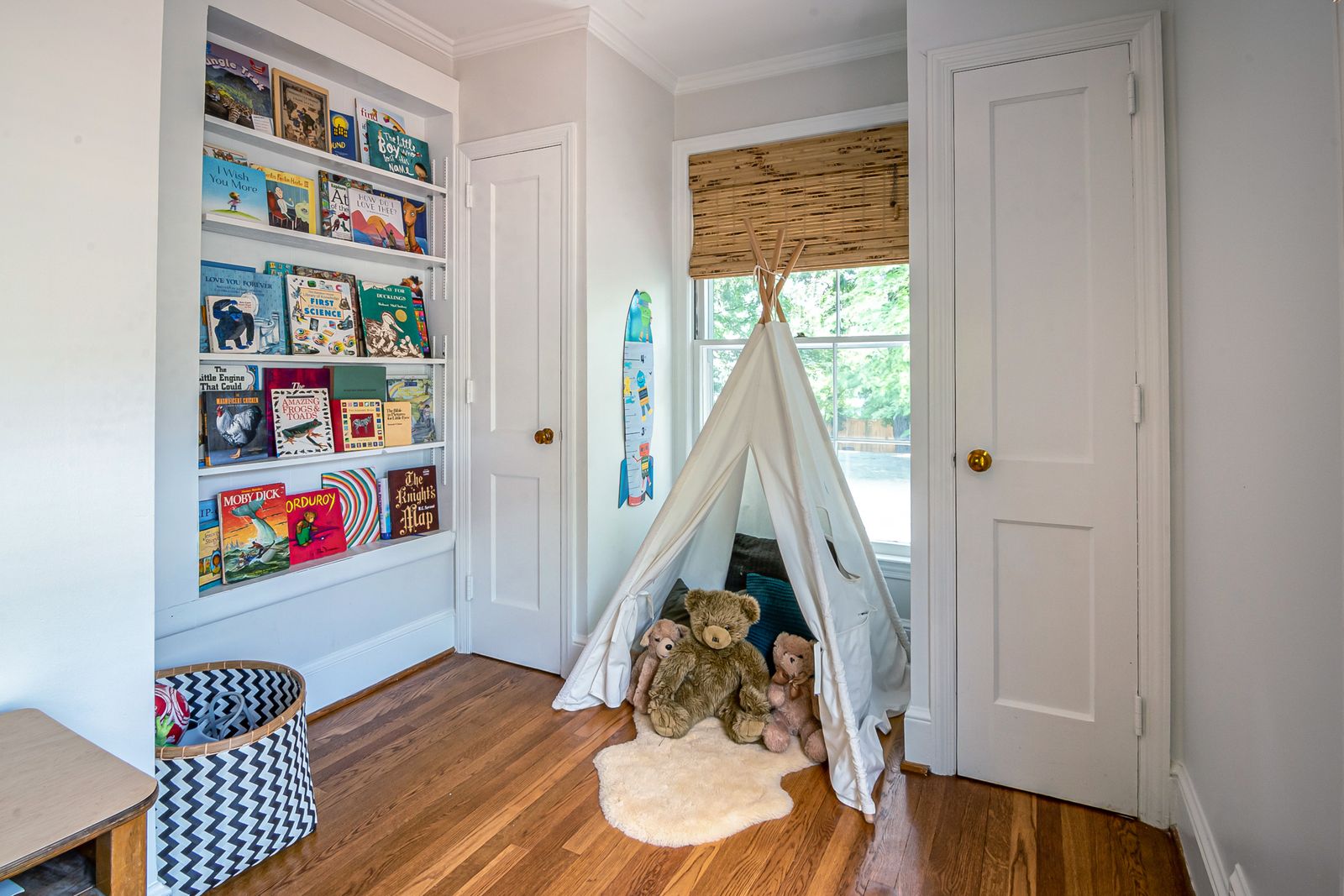
Not every family has a spare room to hand over to play, and most do not need one. An apartment living room, a corner of a shared bedroom, or a slice of a hallway can all support rich, daily play if you plan the space deliberately. The constraint is real, but it is a design problem, not a dead end.
This guide covers how to carve out genuine play zones in small and shared spaces, keep them from swallowing the room, and make them pack down when the space has to do something else.
Define the zone without walls
In a small home, play has to share space with everything else, so the first job is to make a play area feel distinct without building anything permanent. You want a clear “this is the play spot” signal that can appear and disappear.
A few low-cost ways to define a zone:
- A floor mat or rug. Nothing marks a play area more clearly than a defined patch of soft floor, and it can be rolled up when the space changes use.
- A low shelf as a soft boundary. Used as a room divider, it separates play from the rest of the room while staying open and light.
- A consistent corner. Children read repetition as structure. The same corner, used the same way, becomes “the play zone” without any furniture marking it at all.
The point is psychological as much as physical. A defined zone helps children focus their play and helps the room recover its other functions when play is done.
Go vertical with storage
Floor space is the scarcest resource in a small home, so storage has to climb the walls. Every bin on the floor is play space lost; every item moved to a wall is play space regained.
Wall-mounted shelves, pegboards, and hanging organisers all move clutter up and off the floor. Keep the lowest tier within your child’s reach for daily-use toys, and use the higher tiers for rotation stock and adult-managed items. The result is a small footprint that still holds a lot.
Two cautions for shared and rented spaces. First, anchor anything tall to the wall: in compact rooms, furniture and children are close together, and stability matters more, not less. Second, if you cannot drill, lean into freestanding vertical pieces and over-door organisers that deliver height without fixings.
Choose furniture that folds away
In a room that has to be a play space and then something else, the furniture itself needs to pack down. Pieces that collapse, fold, or transform are worth far more per square metre than fixed ones.
Modular soft seating is especially suited to small homes. A couch that folds away into play can be a fort or a tunnel during the day and reassemble into ordinary, tidy seating by evening, so the same footprint serves both play and family life. Because the pieces are light and rearrange by hand, even young children can help with the changeover, which turns pack-down into part of the routine rather than a chore that falls to you.
Look for the same flexibility throughout: nesting tables, stools that double as storage, floor cushions that stack into a corner. The question to ask is whether a piece can change what it is when the room needs to change what it does.
Make shared bedrooms work
A shared bedroom carries extra demands: it has to support sleep and play, and often two children with different needs. The aim is for each child to have something that is clearly theirs, even when nearly everything is shared.
- Give each child a personal zone, even a small one. A single shelf or a labelled bin that belongs to one child reduces friction more than its size suggests.
- Separate sleep from play visually. Keep toys out of the immediate bed area so the space still reads as restful at night and play does not bleed into bedtime.
- Use the bed as infrastructure. Under-bed storage on rollers is some of the most valuable space in a shared room, ideal for rotation stock or bulky sets.
In tight quarters, soft, movable seating earns its keep again here: a spot to read or play that tucks away at night and does not compete with beds for permanent floor space.
Keep the volume down
Small spaces punish excess fast. The same number of toys that merely clutters a large playroom can make a small room genuinely unusable, so volume control is not optional.
Toy rotation is the natural partner to small-space living. Keep only a portion of the collection out and store the rest, and you get the play value of a large collection within a footprint that stays workable. In a small home, rotation is less a nice-to-have and more the thing that keeps the space livable at all.
A few small-space habits reinforce it:
- One in, one out. New toys arriving means something leaving, or the room loses the battle.
- Favour open-ended toys. Blocks, figures, and art supplies deliver more play per cubic centimetre than single-use plastic that does one thing.
- Tidy daily, not weekly. In a small space, a quick nightly reset stops mess compounding into something that takes an afternoon.
The mindset that makes it work
A small home does not limit play; it focuses it. With clear zones, vertical storage, furniture that folds away, and a collection kept deliberately modest, an apartment or a shared bedroom can support play that is every bit as rich as a dedicated room, often richer, because nothing is wasted and every piece has to earn its place.
The space you have is enough. The trick is designing it so play can appear when it is wanted and step aside when the room has another job to do.